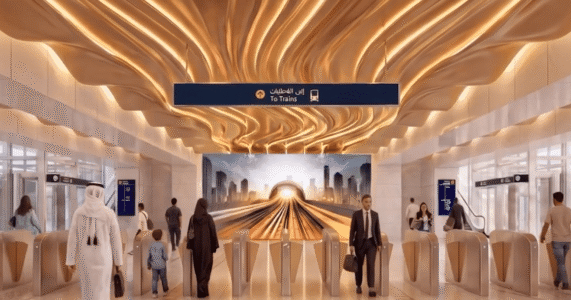
Dubai is preparing for one of the most ambitious transport projects in its modern history with the proposed Dubai Metro Gold Line — a massive underground transit expansion expected to cost around Dh34 billion ($9.25 billion). The new route is designed to dramatically reshape mobility, reduce road congestion, and support the emirate’s long-term urban growth plans through 2040. (thenationalnews.com)
Officials say the project will play a central role in Dubai’s broader strategy to create a more sustainable, connected, and transit-oriented city as the population continues expanding rapidly. (khaleejtimes.com)
What Is the Dubai Metro Gold Line?
The Gold Line is expected to become Dubai Metro’s fourth major route after the Red, Green, and Blue lines. Unlike previous expansions, much of the Gold Line is planned as an underground system crossing some of the city’s most densely populated and commercially important districts. (arabianbusiness.com)
Although final station details are still under development, reports indicate the route could connect key areas including:
- Bur Dubai
- Business Bay
- Meydan
- Dubai Creek Harbour
- Al Quoz
- Jumeirah districts (khaleejtimes.com)
The project is expected to significantly improve east-west mobility within the city and reduce dependence on private vehicles.
Cutting Car Trips and Traffic Congestion
One of the primary goals of the Gold Line is reducing road congestion across Dubai.
The Roads and Transport Authority (RTA) estimates that Dubai’s population could surpass 7.8 million people by 2040, creating major pressure on roads and transport infrastructure. (rta.ae)
By expanding metro access into currently underserved neighborhoods, officials hope to shift more residents away from private cars and toward public transportation.
According to Dubai’s Urban Master Plan 2040, the city aims to increase the share of trips made through public and shared transport from around 21% today to 45% by 2040. (dubai2040.ae)
Transport analysts say underground rail systems are especially important for high-density cities because they can move large numbers of people without occupying additional road space.
Property Values Expected to Rise
Real estate experts believe the Gold Line could significantly increase property values in areas located near future metro stations.
Historically, Dubai properties located close to Metro stations have shown stronger rental demand, higher occupancy rates, and better long-term price appreciation. (propertyfinder.ae)
Analysts expect neighborhoods connected by the Gold Line to experience:
- Increased residential demand
- Higher commercial activity
- Improved accessibility
- Stronger investment interest
- Faster urban development (khaleejtimes.com)
Developers are already closely monitoring potential station zones as Dubai continues expanding toward mixed-use, transit-oriented urban planning.
A City Built Around Public Transport
The Gold Line forms part of Dubai’s wider ambition to become one of the world’s most advanced smart mobility cities.
Dubai has aggressively invested in:
- Autonomous transport systems
- Electric mobility
- AI-powered traffic management
- Smart parking infrastructure
- Expanded cycling networks
- Metro and rail expansion (rta.ae)
The city’s leadership increasingly views public transport not only as infrastructure, but as a core economic and environmental strategy tied to quality of life and sustainability goals.
Why Underground Infrastructure Matters
Unlike elevated metro lines, underground systems are more expensive but offer several advantages in dense urban areas.
Benefits include:
- Reduced surface congestion
- Faster travel times
- Better integration into existing districts
- Lower visual impact on urban landscapes
- Increased land-use efficiency (thenationalnews.com)
Urban planners say underground transit becomes increasingly important as Dubai’s central districts become more densely developed.
Dubai’s Population Boom Drives Expansion
The metro expansion is closely tied to Dubai’s rapid demographic growth.
The emirate’s population recently surpassed 3.8 million residents and continues growing through immigration, business expansion, tourism, and foreign investment. (globalmediainsight.com)
Officials expect millions of additional residents and visitors by 2040, especially as Dubai continues positioning itself as a global hub for finance, technology, tourism, and logistics.
Without major public transport expansion, experts warn road congestion and commuting times could rise dramatically over the next decade.
Sustainability and Climate Goals
The Gold Line also supports Dubai’s environmental goals.
Reducing private car usage could help lower:
- Carbon emissions
- Fuel consumption
- Traffic-related pollution
- Urban congestion costs (dubai2040.ae)
The UAE has increasingly emphasized sustainable urban development as part of its long-term economic diversification and climate strategies.
Public transportation projects like the Gold Line are expected to become central components of that transition.
Looking Ahead
While final timelines and route details are still evolving, the Dubai Metro Gold Line is already being viewed as one of the city’s most transformative future infrastructure projects.
If completed as planned, the underground line could fundamentally change how millions of residents move through Dubai — reshaping commuting patterns, urban growth, real estate development, and the city’s long-term sustainability strategy through 2040.