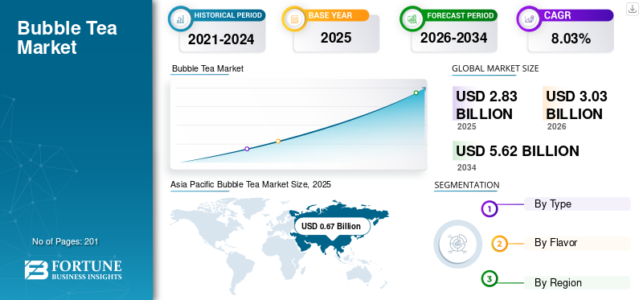
The global bubble tea market is experiencing rapid expansion as the once niche Taiwanese beverage continues evolving into a mainstream global industry driven by younger consumers, social media culture, flavor innovation, and café expansion worldwide.
Industry forecasts now estimate the global bubble tea market will surpass between $5 billion and $10 billion within the next decade depending on the methodology used by different research firms.
The Market Is Growing Faster Than Many Traditional Beverage Categories
Recent market reports estimate the global bubble tea industry was valued between approximately $3 billion and $4 billion in 2025, with projected compound annual growth rates ranging from 7% to over 13% through the early 2030s.
According to Grand View Research, the market could exceed $8.3 billion by 2033, while Future Market Insights projects it may approach $10 billion by 2036.
Analysts attribute the growth to several major trends:
- Rising popularity among Gen Z and millennials
- Expansion of Asian food culture globally
- Increasing café and franchise penetration
- Social media visibility through TikTok and Instagram
- Customizable drink experiences
- Demand for premium and experiential beverages
Asia-Pacific Still Dominates the Industry
Asia-Pacific remains the world’s largest bubble tea market, accounting for roughly 44% of global market share according to Fortune Business Insights.
Taiwan, where bubble tea originated during the 1980s, continues serving as the industry’s innovation center, while China, Japan, South Korea, and Southeast Asia remain major growth engines.
However, the fastest international expansion is increasingly happening outside Asia, especially in:
- North America
- The United Kingdom
- Europe
- The Middle East
- Latin America
The UK market alone is projected to grow at a CAGR of nearly 14% through 2033.
Bubble Tea Is Becoming Mainstream
What was once considered a niche Asian specialty drink is now entering mainstream café culture worldwide.
Industry reports show bubble tea is no longer limited to dedicated boba shops. Cafés, dessert bars, coffee chains, and foodservice venues increasingly add bubble tea menus to attract younger consumers and boost beverage sales.
Analysts say the drink’s success comes partly from its flexibility:
- Milk teas
- Fruit teas
- Matcha-based drinks
- Dairy-free alternatives
- Popping boba
- Low-sugar options
- Seasonal flavors
This adaptability allows brands to constantly refresh menus and create social-media-friendly products.
Franchise Expansion Is Accelerating
Global bubble tea chains are now becoming major international franchise businesses.
One of the clearest examples is Gong Cha, one of the world’s largest bubble tea brands, which recently attracted private equity interest in a potential deal valued near $2 billion.
Founded in Taiwan in 2006, Gong Cha has expanded to nearly 2,200 stores across 32 markets worldwide.
Other major global chains include:
- Chatime
- Sharetea
- Kung Fu Tea
- CoCo Fresh Tea & Juice
- Xing Fu Tang
The rapid franchise expansion reflects growing investor confidence in the long-term potential of the category.
Health and Customization Trends Are Reshaping the Market
While bubble tea traditionally faced criticism for high sugar content, many brands are adapting to changing consumer preferences.
Modern bubble tea menus increasingly offer:
- Reduced-sugar customization
- Plant-based milk alternatives
- Organic tea ingredients
- Fresh fruit infusions
- Functional ingredients like collagen or probiotics
Matcha-based drinks and fruit teas are currently among the fastest-growing segments.
Consumers are also demanding more premium ingredients and visually distinctive drinks that combine taste with “Instagrammable” presentation.
Social Media Continues Fueling Demand
Few beverage categories have benefited from social media as much as bubble tea.
TikTok, Instagram, and YouTube have helped transform bubble tea into a global lifestyle product associated with youth culture, customization, and aesthetic food experiences.
Industry analysts say visually appealing drinks, colorful toppings, and limited-edition collaborations continue driving viral consumer engagement.
The trend has helped bubble tea brands market themselves organically through user-generated content rather than relying entirely on traditional advertising.
Challenges Still Exist
Despite rapid growth, the industry still faces several challenges.
Reports point to issues including:
- Rising ingredient costs
- Dependence on Asian supply chains
- Increasing market competition
- Sugar and health concerns
- Operational complexity for cafés
- Sustainability concerns around plastic packaging
Some analysts believe the market is now shifting from “rapid expansion” toward a more mature phase focused on quality, operational efficiency, and brand differentiation.
The Future of the Bubble Tea Industry
Industry forecasts suggest bubble tea will continue expanding far beyond its original niche.
Growth areas expected over the next decade include:
- Ready-to-drink packaged bubble tea
- Online delivery integration
- Premium café concepts
- International franchising
- Functional and wellness-oriented drinks
- Sustainable packaging innovation
As global consumers increasingly seek customizable and experience-driven beverages, bubble tea appears positioned to remain one of the fastest-growing segments within the specialty drinks market.